Desert activities
Camel rides, dune walks, sandboarding, stargazing and photography, and how we confirm each one before you book.
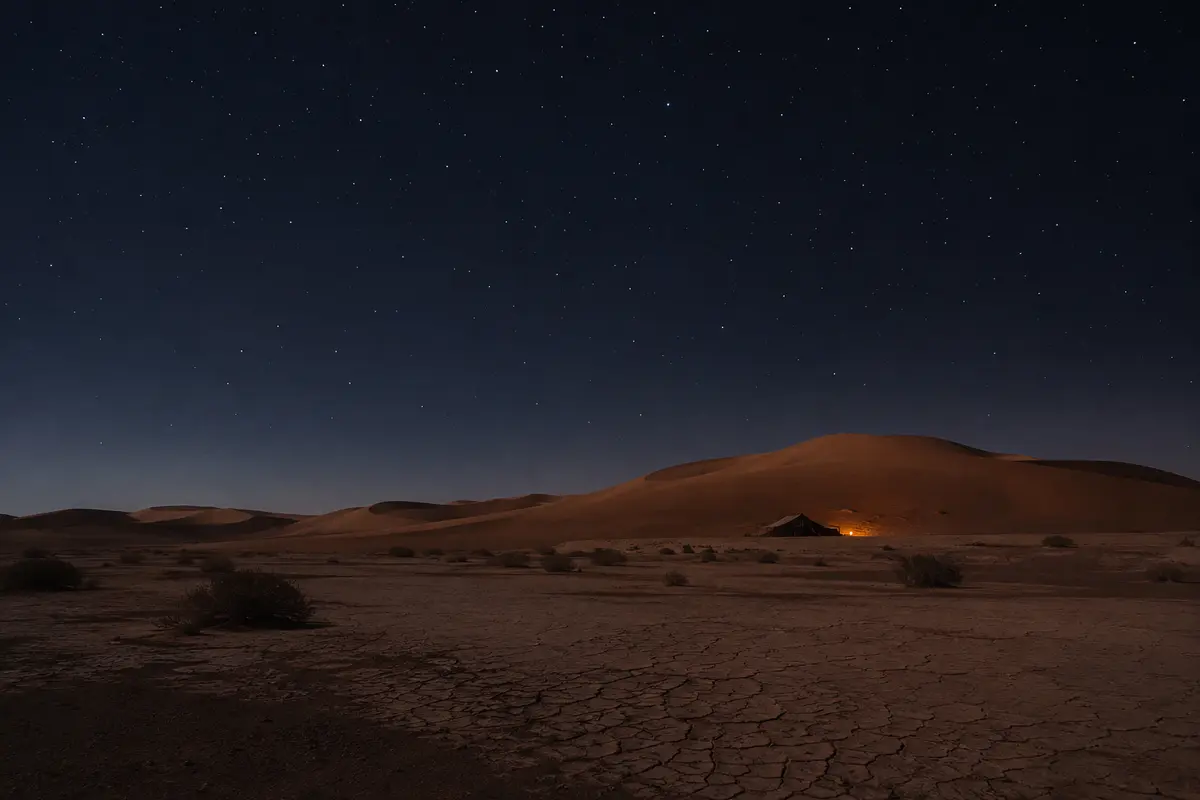
Far from towns and roads, the sky over the dunes can be very dark on a clear night. For many travellers the hour after dinner, lying on cool sand and looking up, is the part of the trip they remember. How much you see depends on the moon and the weather, and we cannot promise either.
Erg Chigaga is a long way from the nearest towns, and there is no road or village at the dunes. With little artificial light in any direction, a clear night can be very dark, and the number of stars visible to the naked eye can surprise people who live in cities.
That said, the dunes are not a laboratory. Camps use some light, vehicles come and go, and the conditions on the night matter far more than the place itself.
The moon makes the biggest difference. In the nights around the new moon the sky is at its darkest, and faint stars and the Milky Way are easiest to see. As the moon grows, it lights the dunes and washes out the fainter stars. A full moon over the sand is a sight of its own, bright enough to walk without a torch, but it is not the night for deep-sky viewing.
The moon also rises and sets at different times through the month, so even on a bright-moon trip there may be darker hours before moonrise or after moonset. Check a moon calendar when choosing your dates if the stars matter to you.
Skies in the region are often clear, but not always. Cloud can build at any time of year, and a single cloudy night can cover the sky entirely. Two nights at the dunes give you a better chance than one.
Wind can lift fine dust and sand into the air, especially in spring, which makes the sky hazy and dims the stars close to the horizon. Strong wind also makes it unpleasant to sit outside for long.
Winter nights are long and often crisp, but cold. Summer nights are warm, and in summer the brightest part of the Milky Way is generally easier to see in the evening sky than in winter. Spring and autumn sit in between. See the weather guide for the broad seasonal patterns.
Night photography needs a camera that allows long exposures, a sturdy tripod and some patience. Spare batteries help, because cold drains them faster. Our desert photography page has more on protecting your equipment.
On camel treks, some people choose to sleep outside on clear, calm nights. At fixed camps this may or may not be possible; ask us. See camel trekking and desert camps for the options.
We plan for good conditions, but we cannot control the sky. We do not promise a clear night, a view of the Milky Way or any particular sight. If stargazing is the main reason for your trip, tell us when you ask for a quote and we suggest dates and a trip length that give you the best chance.
Camel rides, dune walks, sandboarding, stargazing and photography, and how we confirm each one before you book.
One night at a desert camp, with Lac Iriki on the way in and sunset on the dunes.
Two nights at a desert camp with a whole day in the dunes for walks, sunrise and slow time in the sand.
Simple bivouacs, standard camps and luxury set-ups compared, with the questions to ask before you book.
Autumn, winter, spring and summer in the dunes, and what each season means for your trip and your bag.
Send your dates and group size. We reply with a written itinerary and price — no payment needed to ask.