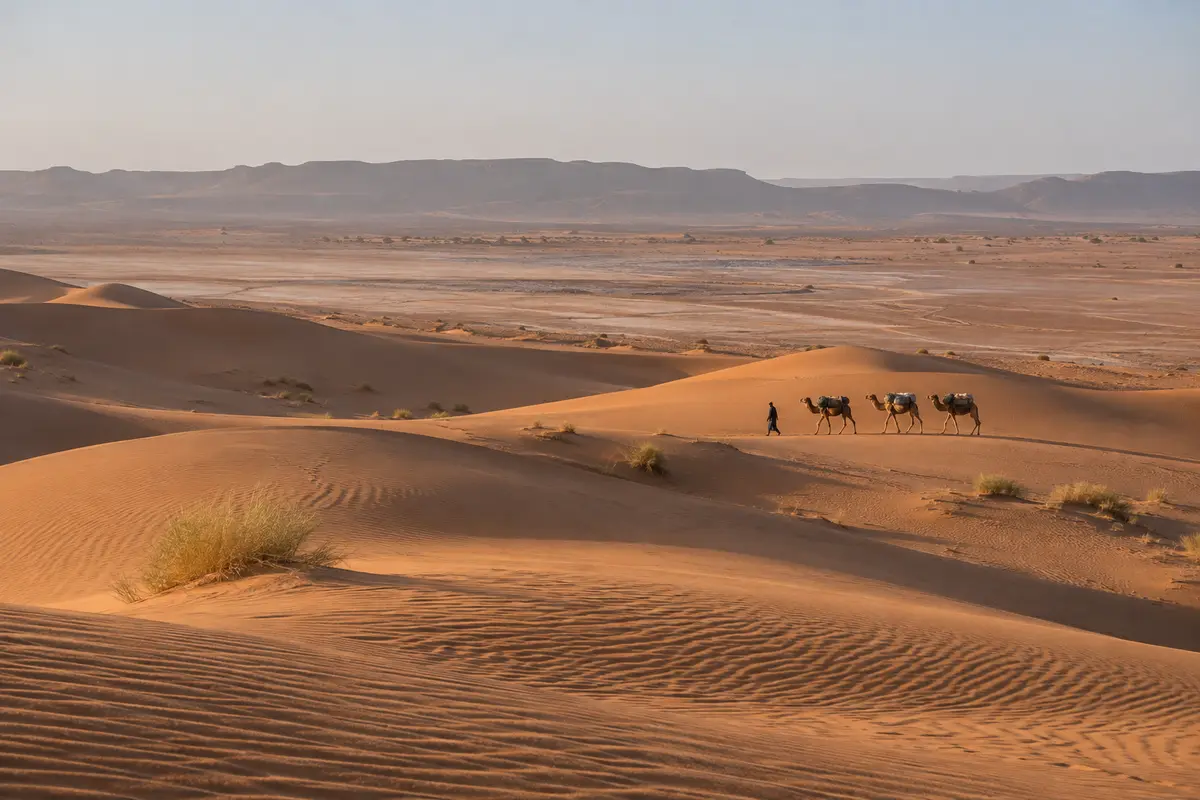
3-day camel trek
Walk towards the dunes for three days with a small camel caravan, sleeping two nights at simple mobile bivouacs.
Private trip Trek Price on request
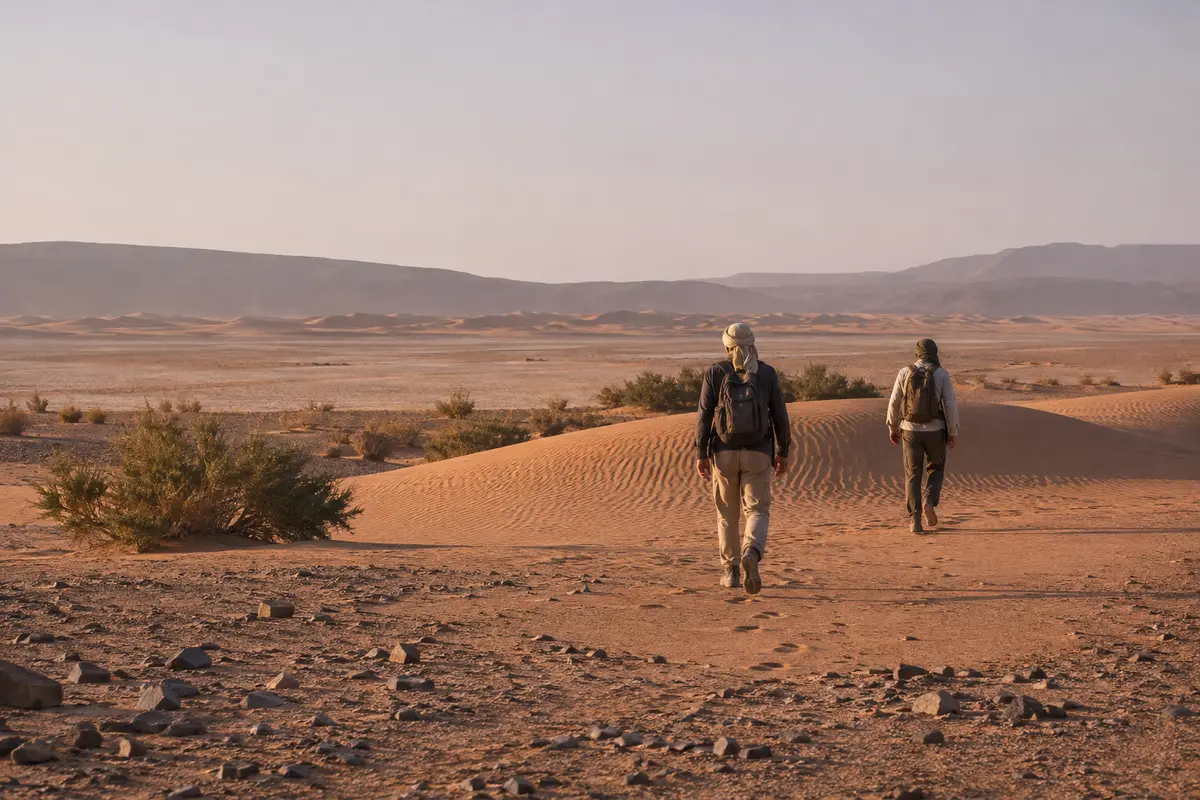
Walking is the slowest and, for many people, the most rewarding way to reach Erg Chigaga. Here is how a dune walk, a short camel ride and a multi-day camel-supported trek differ, and how to choose between them.
People use the word “trek” for quite different experiences. It helps to be clear which one you have in mind.
Every overnight trip to Erg Chigaga includes time on foot. From camp you can walk up the dune ridges at sunset and sunrise, or head deeper into the sand for a few hours on a longer stay. These walks need no special preparation beyond good sun protection and some patience with soft sand. If walking is the main reason for your trip, the 3-day tour gives you a full day in the dunes with a vehicle to take you there and back.
A short camel ride near camp, often at sunset or sunrise, is a common addition to an overnight 4×4 trip. It is a gentle experience and not a trek. We confirm whether it can be arranged for your date and whether it is included or an extra.
This is a different kind of journey. Over several days you walk across the desert while a small team and their camels carry the luggage, water and camp equipment. Each night you sleep at a simple mobile bivouac set up for your group, away from the vehicle tracks and the larger camps. Riding sections can usually be arranged for parts of the day, but the heart of the trip is walking.
Our camel trekking page goes into detail on pace, camps, water and how the camels are looked after.
| Trek | Nights | Illustrative walking per day | Suits |
|---|---|---|---|
| 3-day trek | Two | Around 3 to 5 hours | A first desert trek |
| 4-day trek | Three | Around 4 to 6 hours | More time and a deeper route |
The walking times are illustrative. The real stages depend on the route, the season and your group, and we set them out in your itinerary. Longer treks can be discussed on request.
A camel-supported trek suits travellers who:
It is less suited to anyone with knee or back problems that make walking in soft sand painful, to very young children, or to travellers who want the comfort of a fixed camp with a private bathroom. In those cases, a 4×4 trip with dune walks from camp is a better fit.
The starting point is agreed when you book. Treks usually begin on either the Foum Zguid side or the M’Hamid side, with a 4×4 transfer from town to the trailhead where the camel team meets you. The 4-day trek can also start from Marrakech with a transfer arranged on request, although that transfer takes up a large part of the first day.
The M’Hamid side is widely used for camel treks and can suit travellers coming through the Drâa valley. The Foum Zguid side suits those arriving along the N12 from Ouarzazate or Taznakht. Neither is better for everyone, so tell us your wider route and we will suggest the start that makes sense.
On a typical trek you walk with a guide, a cameleer who looks after the camels, and a cook. The exact team depends on your group size and route and is confirmed in your quote. They set the pace, choose the camp each evening and prepare meals, so you can concentrate on walking.
Trekking is most comfortable in the cooler months. Days can still be warm in the sun while nights are cold, so layers matter. Spring can bring strong winds and blowing sand. See the weather guide and the travel guide for packing advice, and tell us about any health conditions when you request a quote so we can advise honestly.
Walk towards the dunes for three days with a small camel caravan, sleeping two nights at simple mobile bivouacs.
Four days on foot with a camel caravan and three nights at mobile bivouacs, for walkers who want a deeper desert route.
Five days on foot with a camel caravan and four nights at mobile bivouacs, crossing open desert before the dunes.
A week on foot through remote desert with a camel caravan and six nights at mobile bivouacs, for experienced walkers.
What camel trekking at Erg Chigaga is really like, from walking pace and riding sections to mobile bivouacs, drinking water, camel welfare and leave-no-trace.
Walk towards the dunes for three days with a small camel caravan, sleeping two nights at simple mobile bivouacs.
Four days on foot with a camel caravan and three nights at mobile bivouacs, for walkers who want a deeper desert route.
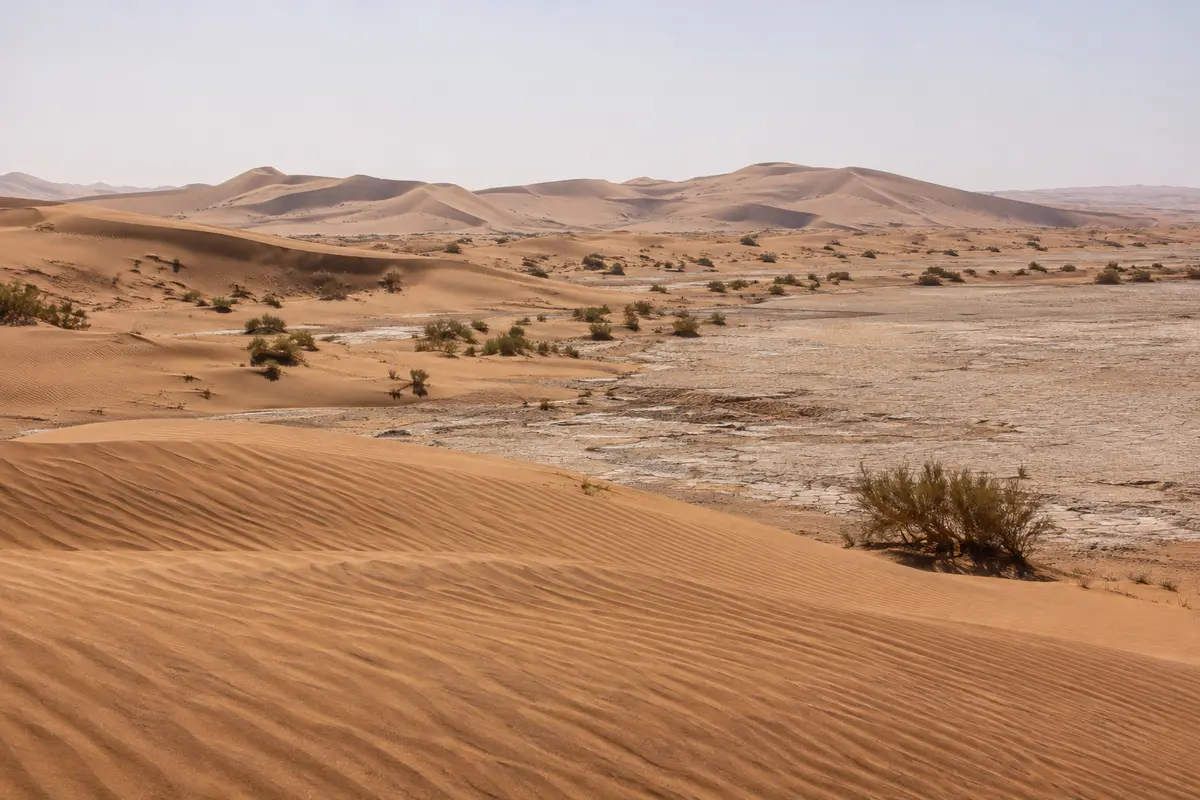
The eastern approach from M’Hamid, where the Drâa valley road ends, and a natural start for camel treks.
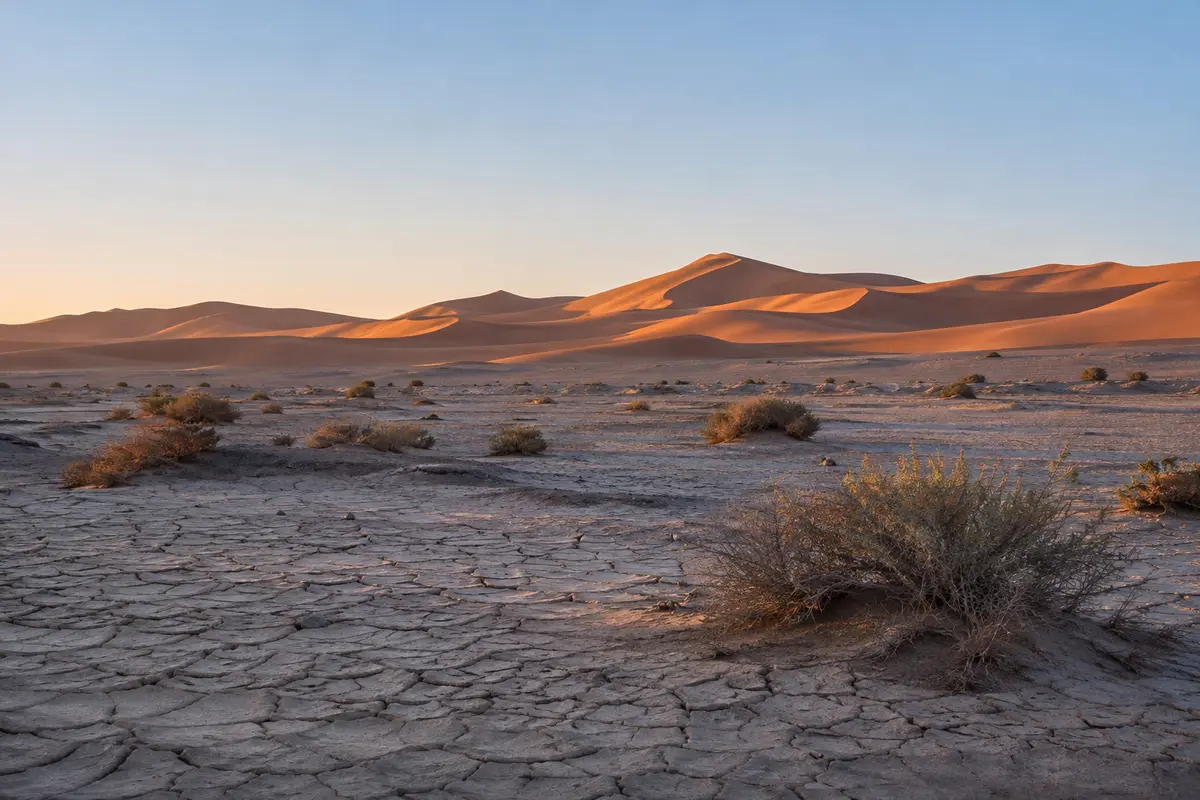
Autumn, winter, spring and summer in the dunes, and what each season means for your trip and your bag.
Send your dates and group size. We reply with a written itinerary and price — no payment needed to ask.